What's the price difference between roughcast and finished decoration in initial deep cleaning? How do pollution levels like cement spots and adhesive marks affect the final quote?
Why do cleaning quotes for the same floor plan vary by 30%–50%? This article explores the differences between roughcast and finished homes, explains a four-tier pollution classification for cement spots and adhesive marks, and details our three-stage pricing model. Using a 120㎡ roughcast home as an example, we break down how unit prices range from 7 to 10.5 per square meter. Plus, three key verification points for homeowners comparing quotes.
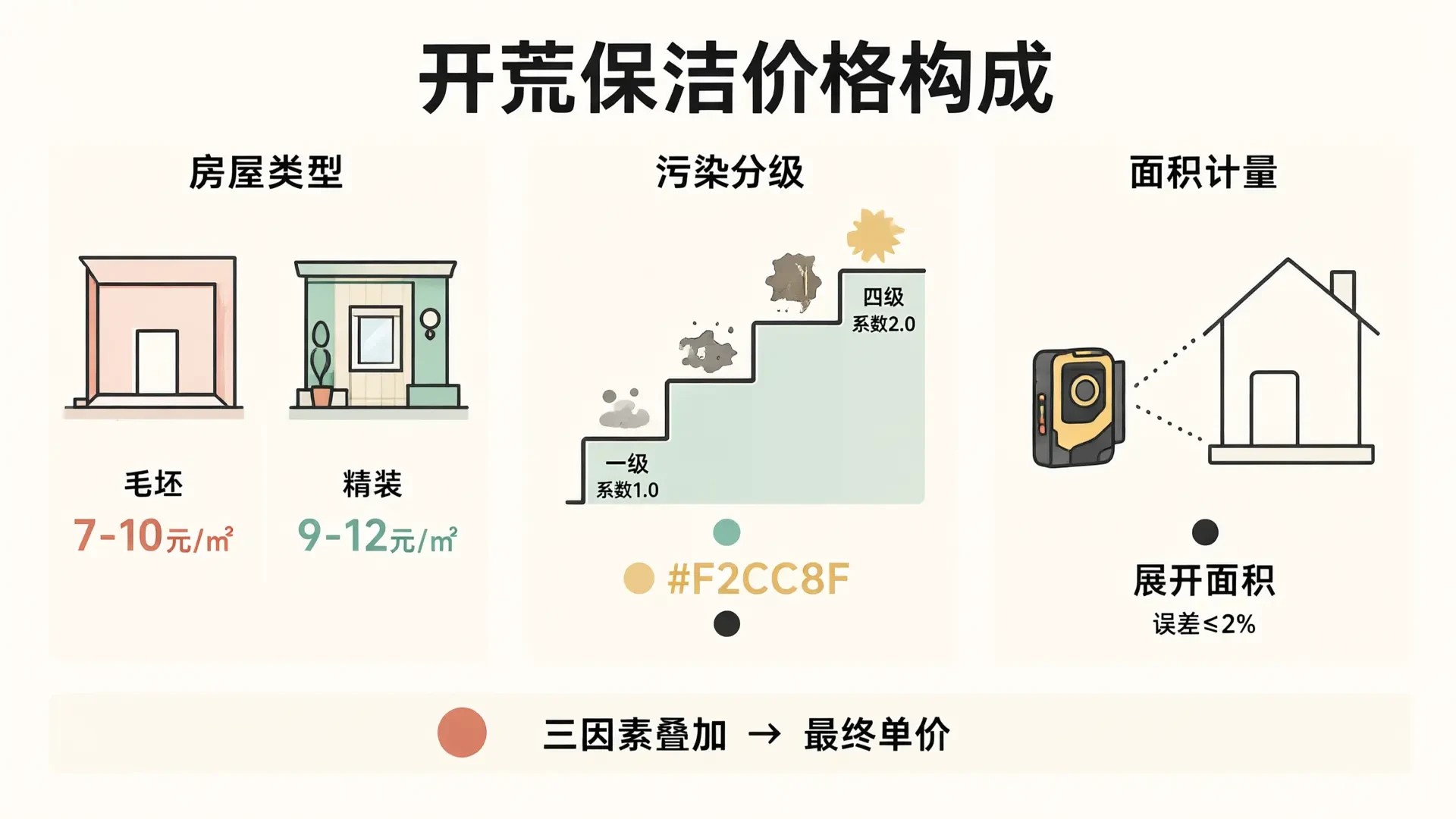
Initial cleaning quotes typically range from 7 to 12 CNY/sqm, with a spread of nearly 100%. For the same apartment layout in the same city, prices quoted by different renovation companies can vary by 30%–50%. This variation stems not merely from profit margins, but from significant differences in the property's handover condition and level of contamination. To accurately compare quotes, homeowners must understand the pricing logic for roughcast versus finished units and how specific contaminants—such as cement spots and adhesive residues—are categorized and priced.
Differences in construction scope between roughcast and finished units
The difference in cleaning difficulty between unfinished and fully furnished homes during the initial deep clean stems from their distinct delivery conditions.
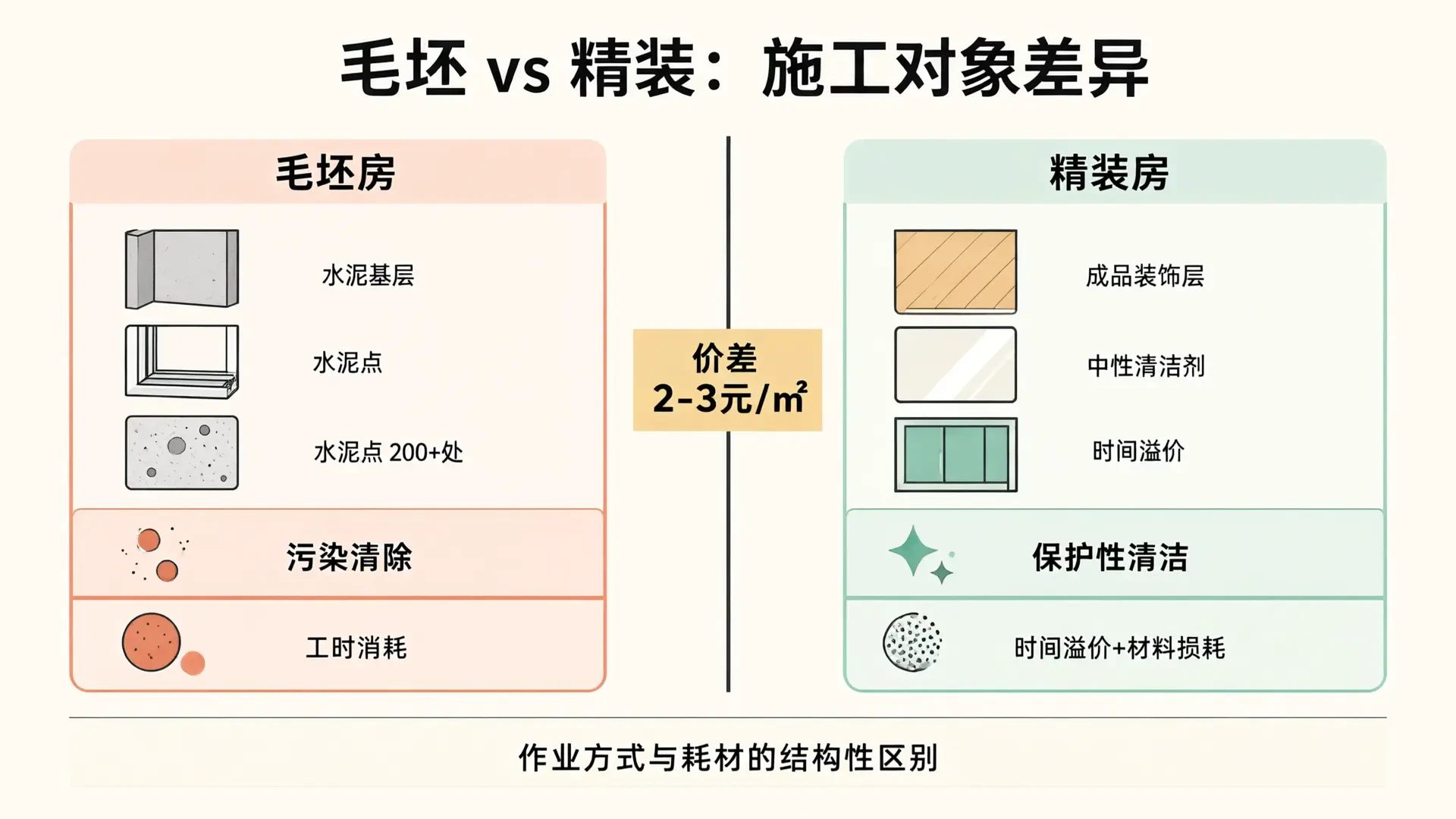
Turnkey delivery surfaces are primarily concrete substrates: floors feature exposed concrete or mortar leveling, walls have cement plaster, window tracks contain heavy construction dust and cement debris, and glass surfaces retain silicone residue from removed protective films. These contaminants share key characteristics: strong adhesion, large coverage area, and the need for point-by-point removal. For example, in a 2025 square meter, three-bedroom turnkey unit completed in 3, we encountered over 200 cement spots on window frames and walls alone, with adhesive residue from protective films affecting all 14 windows across the entire property. Our team of 3 certified cleaners spent 7 hours completing the work, billed at 10.5 yuan per square meter.
Turnkey home handovers include extensive finished finishes: hardwood or tile flooring installed, walls painted with latex or covered in wallpaper, kitchen and bathroom fixtures and hardware fitted, and in some projects, custom cabinetry and appliances included. Post-construction cleaning shifts from "removing construction debris" to "protective cleaning"—ensuring the entire home is cleaned without damaging the finishes. This requires a slower pace, stricter selection of cleaning agents (neutral formulas only to avoid corroding hardware plating or damaging wood floor coatings), and more frequent tool changes.
This pricing difference stems from the distinct cost structures of two property types: bare-shell units incur costs primarily through labor hours for pollution removal, while fully-finished units incur costs mainly through time premiums for protective work and material waste. In our three-tier pricing model, these are categorized into separate tiers: bare-shell cleaning baseline rate is 7-10 CNY/㎡, fully-finished cleaning baseline rate is 9-12 CNY/㎡, with a price difference of approximately 2-3 CNY/㎡, reflecting structural differences in work methods and material consumption.
Contamination Grading: Quantifying operational difficulty from cement points to adhesive marks
Homes in the same tier vary in contamination levels and receive different quotes. This is what the "Contamination Tiering" step of the three-tier pricing method addresses.
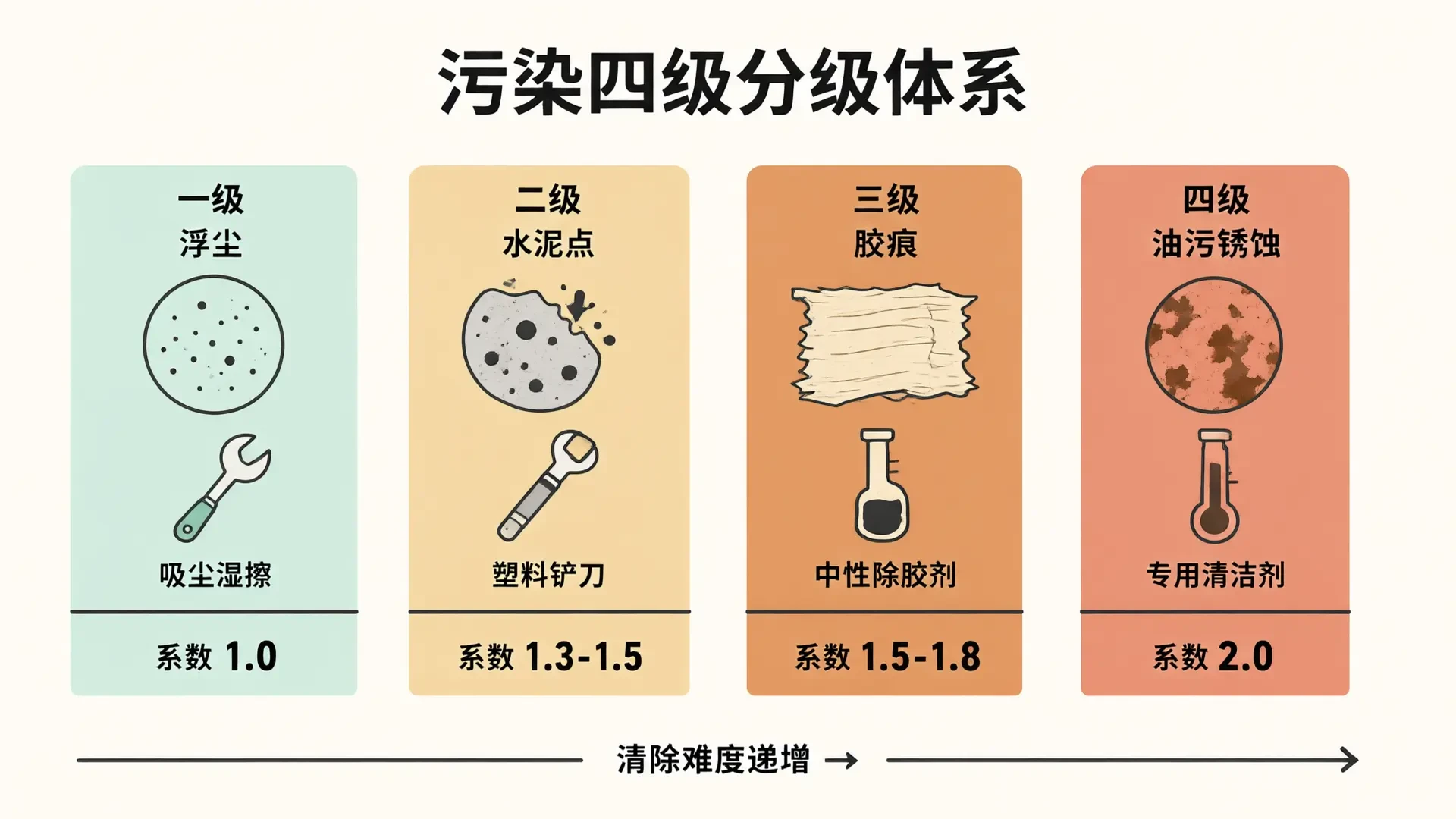
We categorize common pollutants encountered during initial deep cleaning into four difficulty levels, each corresponding to specific tool selection, consumable usage, and labor time coefficients:
Level 1 pollution consists of dust and loose debris. These contaminants adhere to surfaces without forming chemical bonds and can be removed with standard vacuuming and wiping. The labor coefficient is 1.0 (baseline). This level typically applies to ceilings and walls in unfinished homes, as well as floors in fully furnished homes.
Secondary pollution consists of cement spots and paint splatters. Cement spots cluster densely along window frame tracks, baseboard corners, and floor junctions; once dried, they become extremely hard. Removal requires peeling them off point-by-point with a plastic scraper—steel wool must be avoided to prevent scratching glazed tiles or aluminum profiles. This type of contamination carries an efficiency factor of 1.3-1.5, depending on distribution density. In the aforementioned 120㎡ case, clearing over 200 cement spots was one of the primary reasons labor hours increased from the baseline 5 hours to 7 hours.
Level 3 contamination consists of silicone residue and adhesive marks from protective films. After exposure to high heat, removing the glass protective film leaves silicone residue at the junction between the glass and window frame. Apply a neutral adhesive remover to soften the residue for 5 minutes before scraping it off. This type of contamination is characterized by long individual treatment times and requires specific cleaning agents; labor time coefficient: 1.5-1.8.
Level 4 pollution involves heavy grease and rust stains, primarily found in kitchens and bathrooms. Residual cement-based grout at the joints between kitchen countertops and wall tiles, as well as limescale and rust spots on bathroom fixtures, require specialized cleaners and repeated scrubbing, with a labor coefficient up to 2.0.
The practical value of pollution grading lies in assessing pollution levels by area during on-site surveys, calculating a weighted comprehensive labor coefficient, and multiplying it by the base unit price to determine the final quote. For a 120 sqm unfinished apartment with dense Level 2 pollution and Level 3 pollution covering all glass surfaces, the comprehensive labor coefficient is approximately 1.4, raising the unit price from the base 7 yuan/sqm to 9.8 yuan/sqm. In a fully furnished apartment with extensive hardwood flooring and numerous custom cabinets, protective cleaning time premiums can similarly push the unit price to 11-12 yuan/sqm.
Three-tier pricing model
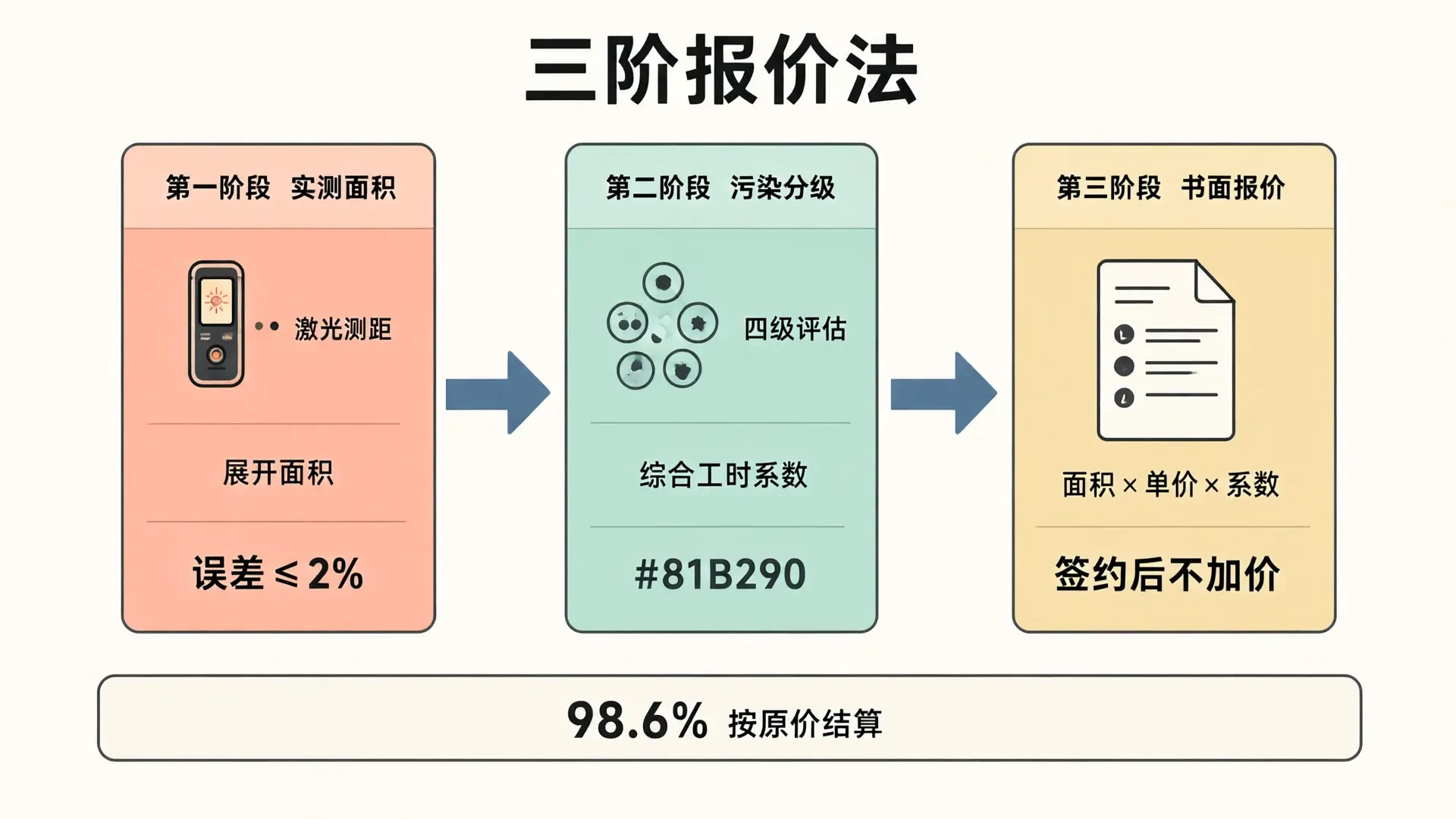
How pollution levels translate into final pricing requires a transparent, end-to-end pricing workflow. We use a three-stage quote process: Measured Area → Pollution Classification → Written Quote.
Phase 1: On-site Measurement. Commercial and project clients receive free on-site surveys. We use laser distance meters to calculate the total expanded surface area with an error margin within 2%. Expanded surface area refers to the total area of all surfaces requiring cleaning, not the building footprint or interior floor area. This includes areas such as the inner side of bay windows, balcony parapets, and the sides of stair treads. Accurate area data is a foundational parameter for pricing and directly impacts the total cost.
Phase 2: Pollution Grading. Surveyors assess the pollution level of each area on-site item by item and calculate the comprehensive labor coefficient based on the distribution ratio from Level 1 to Level 4. The key here is converting "visually dirty" into quantifiable metrics: rather than adding fees based on intuition, we score each item according to pollution type, coverage area, and removal difficulty. Assessment results are recorded in the remarks section of the quote so owners can verify them against the actual site conditions.
Phase 3 is the written quote. The quote details area, unit price, crew size, estimated hours, add-ons, and exclusions—no price increases after signing. In 2025 years, 428 written quotes were settled at the original price 98.6% of the time. Price adjustments occur only for contractually defined add-ons, such as homeowners requesting additional cleaning areas (e.g., cleaning inside cabinets added after installation).
The core value of this process is that owners receive not just a rough estimate, but an itemized breakdown they can verify line by line. It clearly states the area, how pollution levels were determined, why the unit price is set at this level, and which items are included or excluded—all in writing. The true meaning of transparent pricing isn't about having the lowest numbers; it's about being able to trace every cent back to its source.
Case Study: Cost Breakdown for an Unfinished 120㎡ Home
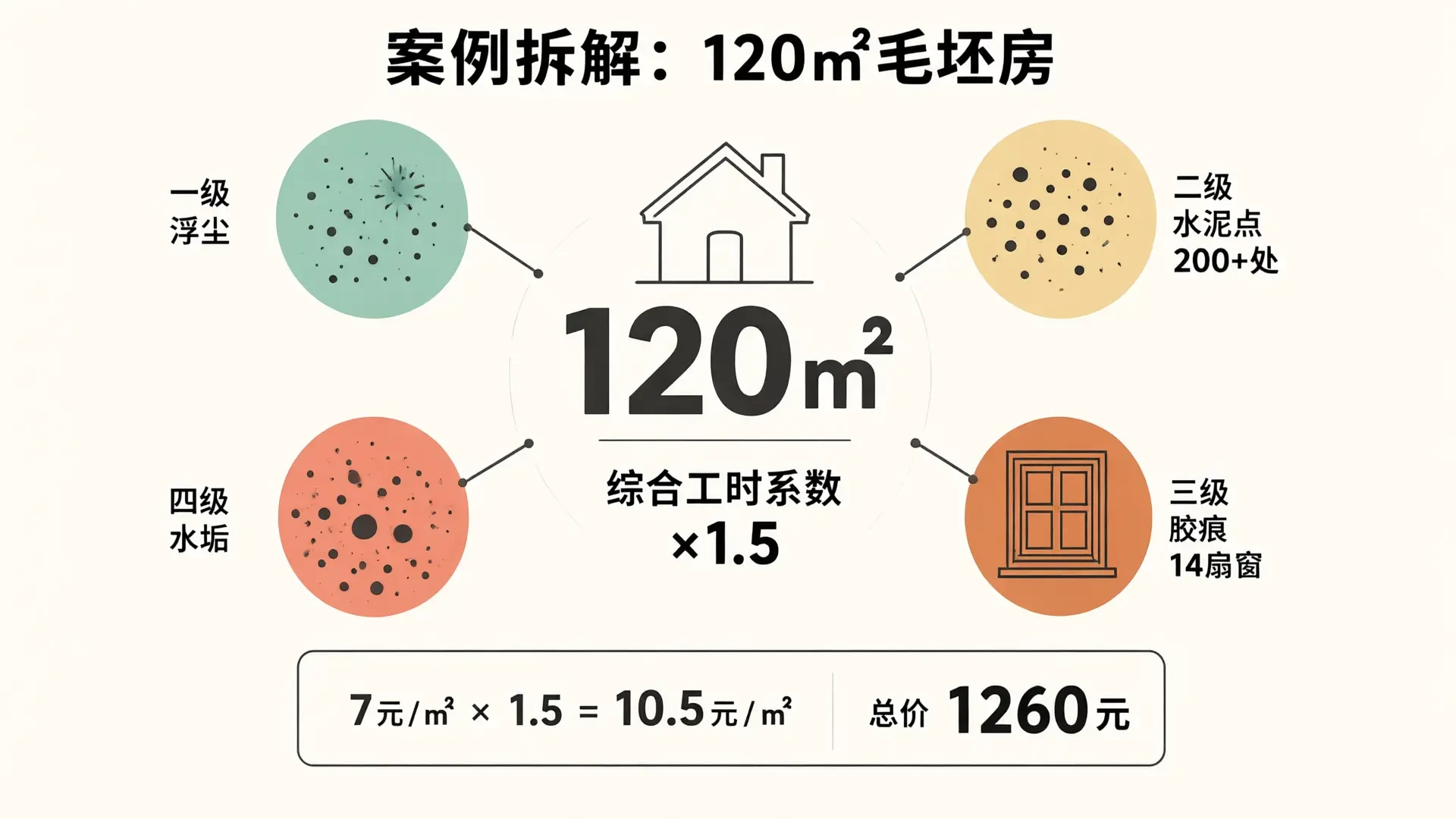
Using a 3-bedroom unfinished apartment of 120 square meters completed in 3 2025 as an example, let's break down how pollution grading affects the final unit price.
The project has a total floor area of 120㎡. The measured expanded area closely matches the total floor area (as an unfinished home with minimal custom cabinetry, the expansion coefficient is approximately 1.0). On-site survey results: All floors and walls are Grade 1 contaminated (floating dust). Window tracks and the floor junction show dense Grade 2 contamination (over 200 cement spots). All 14 window panes have Grade 3 contamination (protective film adhesive residue). Bathroom fixtures exhibit minor Grade 4 contamination (water scale). The comprehensive labor time coefficient is 1.5.
Base unit price is set at the median of the rough-finish tier: 7 CNY/㎡, multiplied by the labor coefficient 1.5, resulting in an actual unit price of 10.5 CNY/㎡. 3 cleaners worked for 7 hours, totaling a settlement amount of 1260 CNY. The process follows the four-color zoning method, dividing the entire home into four zones: Red (bathrooms), Yellow (kitchens), Blue (living areas), and Green (windows). Dedicated colored towels and cleaning agents are used with unidirectional movement to reduce cross-contamination from the industry average of 17% to within 2%. Upon completion, all 12 inspection checklist items were verified; the customer signed off, and rework count was 0.
This case shows that even with identical raw units, pollution distribution can cause unit prices to fluctuate from 7 yuan/㎡ to 10.5 yuan/㎡, a variance of up to 50%. The price is determined not by the area itself, but by the difficulty of removing the contamination layered on top.
3 Key Checks for Owners Comparing Quotes
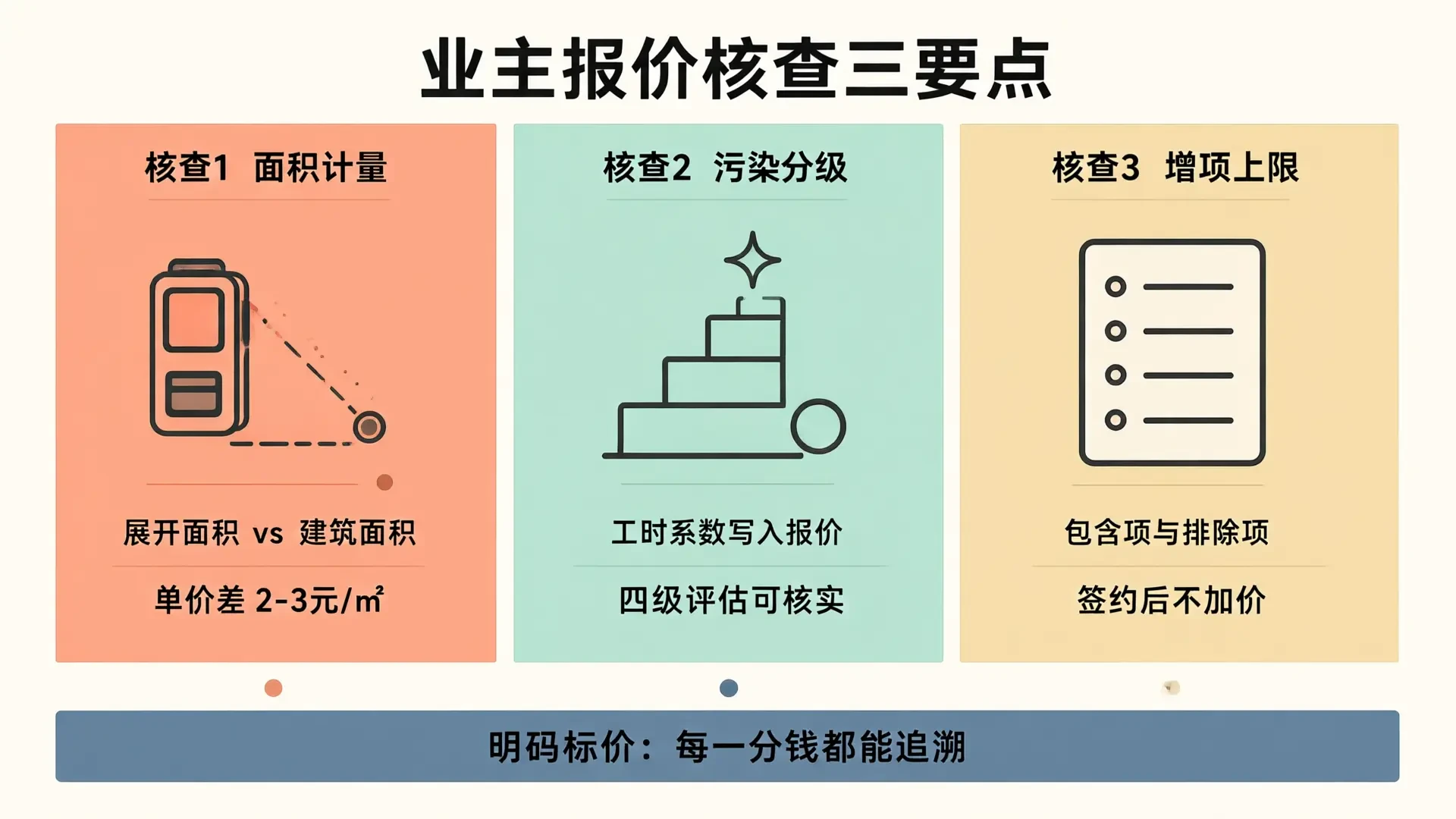
Homeowners can evaluate the reasonableness of quotes from different companies across three dimensions.
First, verify the area measurement method. Unit prices quoted by built-up area versus expanded area can differ by 2-3 CNY/m², though the total cost may remain similar. Expanded area offers greater precision and better reflects actual work volume. If a quote's unit price is significantly below market rates, confirm whether it uses built-up area or omits features like bay windows or balconies.
Second, confirm whether pollution levels are included in the quote. A proper quote should specify the on-site pollution distribution and corresponding labor multipliers in the remarks section, rather than providing a single lump-sum price. Quotes lacking pollution level details are more likely to incur mid-project price increases, as "the site is dirtier than expected" is the most common justification for such adjustments.
Third, verify whether the written quote includes a cap on add-ons and lists exclusions. The three-tier pricing method clearly specifies which items are included (e.g., cleaning both sides of glass, clearing window tracks) and which are considered add-ons (e.g., construction debris removal, billed separately with a defined cap). The promise of no price increases after signing is a fundamental commitment of transparent pricing. This data—2025% of quotes from 428 year(s) settled at the original price—is built on clearly defining add-on boundaries during the quoting phase.
The pricing of initial cleaning is essentially a price on "dirt"—how dirty it is, the methods used to remove it, and the labor hours required. The price difference between roughcast and finished units reflects differences in work methods; the four-tier pollution classification quantifies labor time; and the three-stage quoting method translates these variables into transparent numbers. Understanding this logic helps owners avoid being misled by unit prices alone when comparing quotes, enabling them to assess whether the workload assumptions behind each quote are reasonable.
Key Data
- Initial cleaning quotes typically range from 7 to 12 per square meter, spanning nearly double.
- For the same apartment type and city, quotes from different renovation companies can vary by 30% to 50%.
- One of the main reasons the labor hours increased from the baseline 5 to 7 in the aforementioned 120㎡ case was the removal of over 200 cement spots.
- For fully carpeted hardwood floors with extensive custom cabinetry in a move-in-ready home, protective cleaning premiums can drive the unit price to 11-12 yuan/㎡.
About the Author
Lin Yu Service Standards Supervisor
- Senior Indoor Cleaning and Maintenance Specialist
- Pre-employment Training Instructor with 400+ hours of teaching experience
- Manage skill assessments for 26 cleaners
Responsible for cleaning workflows, detergent selection, and acceptance criteria for both residential and commercial services. Data sourced from our internal operations manual.
Data Definition:Price range and labor hours on this page are based on actual settlement records from YuanYou Cleaning during the same period, calculated by building area or actual hours worked. Excludes holiday surcharges and transportation fees exceeding 30 km. Final quote subject to written estimate after on-site inspection.Statistics Interval2024 to 12, 1-2025, samples from26Actual work records of registered cleaning staff.